Showing posts with label #a3dp. Show all posts

Thursday, February 01, 2018

State-of-the-art 3D Printing in the Design Studio

The increased use of 3D printing in the design office will continue to be a trend in 2018. Normally I'm more focused on architectural 3D printing – on a scale of which one can walk through – however, being smart about the adoption of technological innovations in the office is also important if one wants to build a lot of quality architecture, and here I argue desktop 3D printing has a role in potentially helping save money and increase building design quality. 

A custom architectural light manufacture in California whose pieces average $3000 each recently reported a savings of nearly $90,000 over 40 projects in 18 months with the purchase of an inhouse 3D printing unit. I suspect some costs aren't captured in this estimate because there was probably some initial training required to operate the 200 Series Workbench Classic from 3D Platform efficiently. However, once the unit had a fluent operator, the designers and fabricators' ability to study the proposed design before final production was greatly increased, helping ensure the piece had the form and qualities expected.

Architecture and engineering firms will not be responsible for developing robotic 3D printers. That will continue to be very specialized knowledge. However, one of the most important points to leverage in the design process is the smooth transition of data from prototype to production, with ideally as little post-production as possible. This idea scales to include architectural 3D printing as well, wherein the engineering characteristics of the model to its final production shift even more. One can't cleanly print the REVIT model without some sort of post-processing, either automated or manual. This is again where the topic of data science has the potential to help the most because abstracting the problem to one of data is the type of knowledge needed to effectively design and produce such models, and it's already well established and studied through the field of computer science. 

Having a tangible scale-model supports the design process in other ways beyond the ability to rapidly prototype ideas. Having a model to study also increases the design team's understanding of the proposed building's spatial qualities. One company doing interesting things with scaled models of urban areas is Chicago's Microscape. These city models allow design teams see how the proposed building integrates into the urban fabric and their quite beautiful in their own right. Many clients report loving the tactile nature of these sorts of presentation features, and I think this enthusiasm should be encouraged. If I had to say why clients find such models helpful, I would suggest it's because the models offer more dimensions than 2D renderings to understand the space. This quality is important when clients are trying to understand and solve functional problems with a spatial component. And I would go so far as to say this quality is helpful to designers as well. 


Wednesday, October 18, 2017

Evolving Types of Architectural 3D Printing

Architectural writing allows me the advantage of taking an outsider's view and crash technologies together to draw conclusions. This is why I wanted to bring to reader's attention four current projects that blur the lines between drones and 3D printing on the construction site. This top-down approach is vital to smoothly integrating them into the modern digital design workflow. Ultimately, if my argument is that additive construction techniques are cost-effective and have the potential to raise the quality of the built environment, being open about their research characteristics now is important while they develop into mainstream products of the future. Experimental projects, while valuable learning opportunities, also tend to be prohibitively expensive as positive results are chased with near endless grants to move the subject matter forward. Quality design on a finite budget–big or small–is where most of the market is.

The wonderfully name Ceramic Constellation Pavilion recently erected in Hong Kong shows the sort of slow evolution the industry is seeing (left). This project does have precedents (the though article states "it's the first in the world") in UCLA Berkeley's Bloom 840 piece 3D printed structure(right). The ceramic pavilion increases this to 2000 uniquely printed bricks and makes improvements in the 3D printed material. Whereas Bloom used an esoteric mix of experimental cement, the Constellation project manages to reduce costs by modifying more readily available terracotta. There's an ingenious interlocking brick design used for the structure in which each brick is unique and contributes to the overall final form of the structure, a quality only achievable with architectural 3D printing. But that leaves one important question, what poor soul was responsible for piecing this whole thing together? 

Students of course! The Ceramic Constellation Pavilion being a project of the Robotics Lab at the HKU Faculty of Architecture. But I have a better idea. Or at least argue strongly for a better approach as I only wish it was my idea. For example, 2012 brought a new method to the construction site of letting robotics do the work of placing the bricks. Flight Assembled Architecture was a highly experimental structure, being led jointly by ETH Zurich for their robotic expertise and architects Gramazio and Kohler and Raffaello D`Andrea. Erected in France out of styrofoam bricks it distinctly falls short of what I had in mind. Nonetheless, it easily shows the potential for simpler modular bricks to be placed in a such a way that a more complex form emerges from their arrangement. Patterns can be programed that would drive labours crazy in the real world because of their high-tolerances. This is the exact quality which will allow construction drones to raise the quality of our buildings. It will reduce labour costs while being more effective, but the drones are also more accurate than humans can ever be. With homes and offices built to higher tolerances, one would expect a corresponding increase in quality as well. The exterior could be sealed better against the elements with better placement of insulation etc., each of which contributes to better thermal performance of the structure. 


Since 2012, people have continued to create robots that build and design. A recent project I thought was just great for showcasing the developments in the field was Arup's participation in (the misleadingly named) The DNA of Making in London (see video below). A project in London which features the use of a crazy looking robot which balances itself on wires, controlled by AI, to create and construct the design. I end on it to reinforce that we should be open minded toward what this technology might eventually look like on the construction site. (Sorry about the obnoxious autoplay. Blame Arup.)

Wednesday, September 13, 2017

The Cost-Effective Characteristics Of Additive Construction Techniques


I've been waiting excitedly all Summer to return to the topic of architectural 3D-printing. Finally the latest news coalesced into something of a coherent point about where this technology is going. I first wrote about the above friendly-looking MIT-created robot earlier this year, and it continues to be a convenient reference point from which to start our story: Construction drones and 3D printing are converging in ways nobody expected.

The design studio is still responsible for the design, but the algorithms used in its construction challenge the traditional architecture or engineering firm with a very particular type of expertise. It's a gap in skills I'm not sure exactly how best to respond to; except perhaps to invite in a 3rd-party. In time, machine learning will no doubt come to have a dominant role in streamlining the significant amount of processing needed to make designs machine-readable by construction drones. Some thought will also need to be put into the large geospatial datasets which have now come to represent the construction site, and the structure's coordination within it, because this process has emerged as an area of expertise. Construction drones et al. have to know where they are in 3-dimensions in order to be effective. These challenges might seem daunting to traditional firms, but in reality represent the strengths of digital technology. MIT's research, once refined and commercialized, will offer significant cost savings and increased accuracy when deployed. The construction site might ultimately come to have less people on it, but one, those are the client's savings, and two, lets not forget this shift is creating jobs too, just elsewhere. Getting back to my main point that additive construction techniques are more cost-effective, I argue that firms who start to learn and develop expertise in these areas will begin to gain a competitive advantage against others in the marketplace by potentially offering a cheaper building on a per square foot basis.

A good analogy for why additive construction techniques are so cost-effective can be seen in the use of 3D-printed sand cores in the metal forging industry. ExOne and Voxeljet are two such companies offering the service. Complex sand cores can be built up of whatever component the client needs greatly shortening the production cycle for the final part. There are also active projects researching methods of printing metal directly from a metal-based ceramic-polymer or powder. FromLabs is probably the best known but the field is competitive and many different companies are growing quickly. The fascinating thing about 3D printed metal is how it's managed to advance the subject of material science itself. With all the innovation that's occurring in the field, materials have started to emerge that blur the lines between what is a metal, ceramic or plastic. Australia's Swinburne University of Technology's recent work refining the cementitious material mixture used in architectural 3D printers shows promising results in this vein. The process uses sand and various polymers to create a 3D printed material that shares many characteristics in common with sandstone, but with the added benefit of allowing customization to better suite the goals of the project. Scaling up, D-shape is a UK-based company trying to achieve structural 3D printed concrete. Again – very exciting technology – but limited by its structural qualities. Cementitious 3D printing has the advantage of not requiring formwork, saving both time and materials, and highlighting the fundamental cost-effectiveness of additive construction techniques.

Another way 3D printing is fermenting radical change in architecture is by opening up the possibility of new architectural forms. Again we turn to MIT to reference developments in a new type of structural system made possible (or at least made greatly easier) with 3D printing. Force-line structures have a healthy background in applied mathematics and engineering, but now find expression on the construction site through MIT's research on Stress Line Additive Manufacturing (SLAM). Precise placement of the extruded 3D printed material is key to these structures' strength. With time, methods can be found to optimize material usage and that, combined with the lack of formwork, potentially makes the technology very cost-effective to deploy.

Wednesday, August 09, 2017

Will 3D Printing Make the Construction Industry More Sustainable?

Reporting on the successes of architecture 3D printing, Motherboard updates the status of a project to 3D print a skyscraper in Dubai. Two takeaways from the piece:
  1. As the first 3D printed skyscrapers are being planned, there is little evidence to suggest we should expect current generation concrete 3D printers' CO2 footprint to be any different than traditional concrete-building techniques. This is a concern insofar as concrete production is a particularly energy intensive industry and thus at conflict with some of the carbon-neutral goals of sustainable design. More can be done to reduce the carbon footprint of concrete in general. 
  2. The article highlights the cost-effective nature of 3D printed structures but I am doubtful this should be stressed as the most important quality of sustainable design. In certain constructions of the topic, including issues of housing-accessibility and housing-security in the goals of a sustainable design project is appropriate. But a broadening of the topic is also important to ensure all sources of value in an additive construction tool chain are studied and adapted for business. 
To put one last important characteristic of architectural 3D printing in perspective, additive construction technologies' ability to apply different optimization techniques in order to save materials and increase strength should be highly leveraged in a digital design workflow. This process has the potential to make the built environment look much more organic as these optimized forms share much in common with natural biological processes.

Returning to the skyscraper in Dubai, the research and development the project is leading will continue to be of interest to anyone trying to stay abreast of developments in the AEC Industry. If the method is as cost-effective as they are suggesting, this would be welcomed technology indeed. However, there are many questions remaining as the technology shifts into the mainstream, such as the longevity of the structures after decades of exposure. Modelling from similar materials' behaviour is the most direct way estimate its performance to date. It's worth remembering, jurisdictional approval of such projects depends on the availability of robust engineering data or special approval for the project. Neither route is ideal for large developers looking to reduce risk in design and construction workflows. Jurisdictional and technological issues are unpredictable obstacles on the road to success. 

Wednesday, June 14, 2017

3D Printing in the Design Office

Surveying the complete field of architectural 3D printing, this week instead of studying structures large enough to walk through, we introduce two firms broadly implementing 3D printing across their offices. The Asia Times article is interesting for its insights into this transition, but also what questions it never asks which I think are important from my involvement with the field. Starting with a bit of context, while my architectural education jumped directly to 3D printing, I don't think architectural model-making is going anywhere, but it's important we keep the tradition in a proper modern light, recognizing what's good about scale models and why they're so helpful to the design process. Like many things, digital technology has changed the dynamics of what scale models can do for a design project.  

International architecture firm Aedas had the goal of introducing 3D printing to all of their offices in China. In their reason for establishing the goal Benny Chow, director of sustainability at Aedas, states “We are architects, and we love and understand design. But all customers do not understand design. By using 3D printers and models, we can explain and illustrate our thoughts. It makes it easier for our clients to understand and to make decisions.” Very true. The article goes on to state, "Cost-wise, the investment in 3D technology is minimal compared with the savings." Well anyone responsible for building design management will welcome cost savings in the design process because of better decisions earlier from the client. The characteristics of providing a professional service (as opposed to a consumer good) means the marketplace is also competitive on qualities not necessarily representatives in the cost alone, such as quality, which leads to my second point: 

Here my I go further than the Asia Times article, stressing the role a scale model can play in helping designers understand the complex 3D relationships of a form and different 3D qualities of the form, such as shadows and perspective. This helpfulness is, to a great extent, detached from how the 3D scale model was produced. Establishing a rapid iteration workflow with 3D printing combined with the superb communicative properties of scale models raises the quality of buildings. While Aedas seems to focus on 3D printing benefits to clients, B+H Architects' Toronto studio's piece talking about taking delivery of a Stratasys 3D printer comes closer to illustrating my second point, here quoting at length:

"Designers use scaled models to demonstrate the fundamental form of buildings. 3D printing models enable the possibility of presenting several options at once. For example, possible designs can be made to fit into a scaled contextual layout of the surrounding area (e.g. a city block) to understand how a proposal will integrate into its immediate environment. A physical model can demonstrate that a building will comply with view corridor restrictions and it can also show how a design will complement the neighbouring cityscape as it impacts form in the area.

Advanced tools and technology can multiply possibilities and create endless opportunities, but at the end of the day, the people using technology are integral to project success. Despite the many things that technology can do, people are essential to the curation of data during the process and designers offer a skilled eye for composition to understand what can and can’t be achieved. In the end, comprehensive design solutions are the result of careful curation where possibilities are vetted for sheer aesthetic and other criteria like material availability and cost. Designers can anticipate needs and intuitively connect with what makes the most sense for the context — and there’s no technology in the world that can teach that…yet."

So assuming your firm is humming along taking full advantage of all the benefits 3D printing's offers, there is one last reminder about 3D printers in offices worth repeating: Depending on the printer model, some are really not meant for indoor use. The types Aedas uses which are producing models 24/7 365 days a year require their own specialized room with upgraded ventilation. I'm keeping my hopes up for an environmentally sustainable closed-loop printer. But until then, office design will once again adapt to include an additive manufacturing suite in the design studio. 

Wednesday, March 22, 2017

Architectural 3D Printing Moves Forward with AI

Wow, the field of machine learning and architectural 3D printing is moving fast. I wasn't planning to write about the topic again so soon but I didn't want to let these examples pass without sharing them first. Eureka Magazine has an interesting article up about a small London-based 3D printing firm, Ai Build, which people are going to want to check out. To date, they hadn't been on my radar either. Lately I've been impressed following MX3D's progress on a 3D printed metal bridge in Amsterdam. Ai Build's "Daedalus Pavilion" has similar goals so it's a sign the sector is very competitive. The technology is finally out of the lab but still needs further field research. Recommending architectural 3D printing for anything other than architectural features at this point might be risky, on the other hand, construction company Cazza says it's up to the challenge. They're determined to build a full-scale skyscraper in the Middle East using cementitious 3D printing techniques. The interesting thing here is that while some of the technology is still to be developed for the project, it also piggy backs on well-known and established construction techniques. The tower by Cazza will use cranes as a base of support for the 3D printers. This seems like a really efficient approach in my opinion and is different than the prefabrication techniques, say, used to accelerate Barcelona's Sagrada Familia's completion.

Returning to Ai Build's Daedalus Pavilion, we wish to stress that as this type of technology becomes more widespread, and more and more studios develop the expertise to execute complex generative design programmes, clients are encouraged to raise their expectations as well. This strategy creates a bulwark for our built environment against mediocre 3D printed blobs. Referring to the London installation, descriptively it's a symmetrically deformed surface; maybe some type of hyper-surface. But ultimately these shapes already have a history of use in architecture (in concrete shells). The difference here is that the structure was built by robots with some very interesting underlying software implementations. As people walk around it in a gallery however, I'm not sure how well this story unfolds. It never really breaks away from its nature as an architectural feature. Its engineering challenges are a bit better expressed in my opinion. It looks amazingly delicate. Like a person could lift it up with one arm. Here to keep the whole thing from snapping in half on opening night is the engineering expertise of Arup. I love structural engineering and even love designing strip malls and warehouses, but one has to admit calculating out the forces on lattice structures as shown is not something within every shop's capability to do. Quickly touching on the software before ending, the coders implemented deep learning algorithms during the production phase to improve the accuracy and speed of manufacturing. The approach appears to be quite computationally heavy, hence the involvement by NAVDIA, which I'm assuming brings a substantial amount of electrical engineering and computer science expertise to the project.

A post shared by AI BUILD (@ai_build) on

Tuesday, March 14, 2017

Nano-architecture


We try to deliver developments in materials engineering field because it's a valuable component anyone's ongoing surveillance of the AEC Industry. Engineering specific material qualities shows great promise but has been slow to leave the lab and find a place on the construction site. Useful nano-coatings are starting to emerge onto the market but I find it's the materials' structural and mechanical properties – which often merry contradictory qualities – most impressive. 


Credit: Glotzer Group, University of Michigan.

The first update comes from Northwestern University professor Chad Mirkin who's lab perfected a novel way of combining DNA to produce different crystallization structures. A lot of his research was based on previous advancements in modelling protein folding, one of the most computationally complex branches of applied mathematics, which here was used here in conjunction with other materials to create crystallization structures not previously seen in nature. The basic process harnesses knowledge of how A, C, G, and T nuclides fold but then include other nanoparticles in the self-assembly process to create the crystal structures. Here the medical benefits seem more apparent than the architectural goals, medicine delivery mainly, but different coatings could be developed in the future which have aesthetic or functional value to the AEC industry. His university summarizes his work thusly: "Mirkin is director of the research group that invented the chemistry for conjugating DNA and nanoparticles and a pioneer of the concept of programmable colloidal crystallization with nucleic acids."

The next update was super interesting because of its connection to 3D printing. Normally we promote a much bigger version of 3D printing suitable for architecture and construction, but Washington State University used 3D printing on a microscopic level which still has implications for architecture. Amazing! The details of the project are many but the general idea is that researchers used lasers to etch out their 3D structures from metallic vapour clouds, in this case gold. As the technique advances in sophistication and scale, the properties of these materials, say if carbon is substituted, start to have architectural implications. These materials can be engineered to have very specific mechanical properties of strength and lightness while still retaining certain amount of deflection and flexibility required for safe and productive building. Whole buildings made with of this sort of nano-technology are probably a way off but large-scale manufacturing of 3D printed materials is progressing quickly and there is nothing to say gravity defying architectural features can't be utilized within a decade. Having materials which combine characteristics that historically have always been contradictory openthe door to many creative design options. As adoption evolves, the laws of physics won't change how loads are transferred to the ground, but the structural members themselves could look radically different leading to new building forms heretowith not considered. 

Credit: Washington State University

Tuesday, February 28, 2017

How to Adapt to Disruption Through Collaboration in the AEC Industry


This article begins by raising a red flag that disruption is coming to the AEC industry. A maturing workforce with expertise in building information modelling and computational architecture could not have arrived at a better time to match these challenges. However, business models and best practices around architectural 3D printing and additive construction are still very much in flux and a different type of mindset is needed to successfully tackle these subjects. Education is needed:


  • Building Design Management. Here we strive to understand additive construction techniques, architectural 3D printing, and building information modelling with the tools of business analysis and economics.
  • Digital design. There's a range of digital design characteristics to consider which affect creativity. Starting at the almost childlike interaction with technology through to architecture-specific traits like modularity and prefabrication.


One thing a fair and open society can do to adapt to these changes is collaborate; and here yes I mean in the warm-and-fuzzy sense but also the literal sense. A significant feature of preparing wisely for such a disruption is acceptance of the solution's multi-disciplinary nature. Here I'd like to introduce the work of Swiss-scientist Jonas Buchli in support. His recent research published through the Swiss National Centre of Competence in Research is proposing a drastic change to the construction site, stating "radical focus on domain specific robotic technology enabling the use of digital fabrication directly on construction sites and in large scale prefabrication." Doesn't that sound like science-fiction? Science Daily goes on to describe the importance of multidisciplinary skills in the research, "They bring a comprehensive and interdisciplinary approach that incorporates researchers from architecture, materials science, and robotics."


Jonas Buchli ETH Zurich/Swiss Federal Institute of Technology

As buildings become more complex, the proportion of a structure an architect is qualified to design decreases. This highlights the collaborative role of the contemporary architect. Author Stephen Emmitt suggests "cross-cultural leadership intelligence" is needed and that is a very good way to describe it. Combining different engineering disciplines, construction specialities, and stakeholders into one motivated team still strongly depends on more ancient and subjective leadership qualities like open mindedness and compromise. Building projects are complex and expensive and therefore deserve a great amount of scrutiny and study to drive positive results. 


Understanding economic developments in the field are a bit more complex. To date, I haven't read an authoritative analysis of how the economic structure of the industry will shift when the effectiveness of economy-of-scale methods are reduced. Additive construction reduces the penalty for customization by moving the process dominantly into the software realm. It might take a once-in-a-century economic thinker like Adam Smith to frame our understanding of how these new markets will behave. In other respects, the educational component seems to be taking care of itself. Human playfulness and curiosity have ignited maker spaces across the world and there is lively research in the field into how best to introduce digital design to students of any age. Here readers are encouraged to check out the work of educator Corinne Okada Takara and institutions like MIT's Multimedia Lab which really are the sharp point of the multi-disciplinary architectural practice.


Thursday, January 12, 2017

Engineering 3D Printed Architecture

Last month a small milestone was reached with the erection of a 3D printed concrete bridge over a polite stream in a civic park of Alcobendas, Spain. It caught my attention because it was one of only a few projects I've come across whose engineering was rigorously studied and recorded during the design and construction process, here undertaken by The Institute for Advanced Architecture of Catalonia. The bridge is composed of a 40-foot span made in eight sections, made of recycled materials, which I assume is concrete, but what is the glue? Dear goodness to make a bridge out of this product what on earth is holding it together? So as the reader can see I still have questions despite my best internet sleuthing.


Moving to its design, I was a bit underwhelmed compared to what's coming out of the modern Catalonia region. Reports suggest the design was meant to be reminiscence and twigs and branches, which does relate to its civic setting. And though I think there are some amazingly cool applications of biomimicry in architectural 3D printing this was not what I was expecting; then I saw all the happy people on the bridge in the below attached Spanish-language news report and knew we needed to celebrate this piece on the blog.

This project is an important step in studying the engineering characteristics of 3D printed structures. Jurisdictions need evidenced-based data to judge the suitability and safety of these new structures. One important step is dynamic and static analysis of the bridge, which is actually pretty standard stuff in the industry to the best of my knowledge, but specialized. Where we often fly into the unknown are 3D printed structures' long-term behaviour. The worse case scenario is that the bridge starts to decompose in the first rain. Barring that, municipalities and owners want to know what their maintenance responsibilities will be over the life of the structure. Arriving at a narrow topic from the broad probably makes this a good place to stop and I will keep my more detailed thoughts for the major motion picture.

Tuesday, December 06, 2016

The Very Best Architectural Model Making


A wonderful new museum in Shinagawa-ku, Tokyo makes me want to return again as soon as possible. Reminiscing about my old life in Japan I need not feel guilty about missing this highlight last time since the museum wasn't established until this year. Archi-Depot's goal is to try to restore and display architectural models from some of Japan's leading architects; architects I've been studying for quite a long time actually. International artists are also being included as the collection develops. Lots of different types of architectural model are represented; massing models, site models, architectural features, conceptual etc. The museum, run by Yuta Tokunaga, is apparently soliciting for financial support as well which is something I will definitely look into doing in the future because it's somewhere I'd definitely want to visit. These small pieces are wonderful!


Competing with these stunning handmade models in the 21st century is a new technology and it's time we highlight a studio doing all the right things with 3D printing. MATT Architecture of London has done an excellent job leveraging the rapid prototyping capabilities of 3D printing to design better. Daniel Lauand, architect at MATT Architecture, hits the nail on the head when he explains in the article:

“Whilst architects have always constructed physical models to test and evaluate design decisions, 3D printing opened up the possibility of increasing the frequency and complexity of this iterative process between digital model and physical artefact.”

Increasing the frequency and complexity of the iterations has a significant impact on improving the quality of a design. Or another way of looking at it; making more mistakes in the design process allows more mistakes to be fixed. I always thank the Mythbusters for championing the claim "failure is always an option" and that goes to the heart of why physical massing models etc. are so helpful whether 3D printed or handmade. The complexities are grasped more quickly and problems identified. But only with a 3D printing workflow can that iteration cycle be compressed and costs reduced. The included video narrates MATT Architecture's 3D printing process and features an upcoming project. Props to @all3dp for releasing their article under CC4.0. 

Monday, November 07, 2016

Discrete Brick-by-Brick Architectural 3D Printing Technology


It's interesting how quickly architectural 3D printing is advancing. Take, for instance, my previous post about an Australian brick laying robot compared to the recently revealed Archi-Union of Shanghai's additive construction technology (via dezeen.com). The earlier example looks quite primitive compared to the artistry and grace of the Chinese model. A couple of things to point out: Firstly, the surface which was to be faced with brick is quite unorthodox and a challenge to attempt by hand. I immediately recognized the surface as being computationally derived though by which method I can not tell. I would of course be attracted to defining such a surface with differential equations but for all I can tell maybe the studio just played around with symmetrical NURBS curves. In any case, the end result is certainly more visually stimulating than a plain flat brick wall. This brings us to our second point: completing such a complex surface in brick by hand to the tolerances needed to express the pattern is the main benefit offered by architectural 3D printing in these situations. The subtle gradations required to express the pattern work against the traditional tolerances allowed for when laying brick by hand. Without precision the pattern becomes murky.

Another point which readers might doubt is whether this technology really deserves to be called 3D printing or not. Sometimes we view 3D printing as strictly an extrusion process. I'm comfortable shifting the whole topic to additive construction if that reduces anyone's consternation. I much rather design and build with this technology than fight about its label. In so many ways, but especially when designing, this technology and 3D extrusion are similar in how the design is computationally derived and how tolerances are moved into the software domain. That's why I feel it's worthy of inclusion under the title or architectural 3D printing. Here one can imagine the bricks are just larger discrete elements instead of the fine particulate matter normally associated with 3D printing.

Thursday, October 13, 2016

French Architectural 3D Printing Technology Update

Published two days before my blog post this online article can claim to have beaten me to the story. The article also addresses LafargeHolcim’s work in architectural 3D printing with XtreeE in Europe. However, it adds one tantalizing piece of information I’d like to share with my readers in which I might have been ahead of the curve. The article goes on to describe LafargeHolcim’s goals in architectural 3D printing thusly: “LafargeHolcim has initially pegged three 3D-printed concrete targets: high value-added architecture, affordable housing, and robotics-enabled, precast building element fabrication.” Interestingly I had actually already identified the first two points in some writing on the subject from 2015 (an example of which can be found on my Linkedin profile). The third point referred to in the quote I’m a bit wishy-washy on since I see this factor as facilitating the first two but can see how this can become its own business goal depending on one’s position in the AEC Industry. Anyways, just wanted to say that if one wants to be not just days ahead of the curve, but years, please follow the blog and we’ll try to help build and design as much as possible!

Thursday, September 29, 2016

Mini-Review of French Architectural 3D Printing Project


The picture included above caught my eye the other day: It’s a detail of an architecturally 3D printed project in France by Zurich-based LafargeHolcim and start up XtreeE. (I’ve previously done some architectural 3D printing research with Lafarge Canada when I was at SAIT.) The structure was produced for a kindergarten. If only Canadian school children were so lucky to have such forward thinking planners of educational spaces; alas, Canada rarely has the political will to create high-design, high-concept public buildings. In any case, returning to picture, it shows something very unique about the characteristics of architecturally 3D printed structures, namely, the similarities between architecturally 3D printed forms and organic forms. Architecturally 3D printed structures can be carefully engineered to optimize material – cutting away area that don’t transfer any internal forces – leaving the sort of organic form seen in the image. It’s incredible to think that state-of-the-art materials engineering, applied through architectural 3D printing, results in forms Nature already discovered, but also suggests the method might be on the right track to gaining new efficiencies. Another thing I really like about this sort of solid material engineering is that it's just so bloody difficult to do. Off the top of my head I think only the mighty @Arupgroup could take up the task at the drop of a hat. Though obviously the research arm of LafargeHolcim is not lacking engineering talent. 

Monday, September 19, 2016

Architectural 3D Printing’s Effect On the Real Estate Market


One of the most effective ways to analyze architecture is through its economics and I’ve found one of the best measures of this in particular is the real estate market. Forecasting architectural 3D printing’s effect on the real estate market is a complicated issue and I’m not sure the linked article exactly hits its mark. The uncertainty extends from predicting a technology’s effect – this time a new building system – on the real estate market. Not a lot of research has been done on this issue whereas how different regional pressures effect the real estate market is well understood. So what does the article say? Starting with price: “Three-dimensional printers don’t require labourers, produce much less waste (as materials are fed into the machines), and will be able to erect homes in days instead of months—making them substantially cheaper to build.” What the article hasn’t factored is the R&D costs of developing architectural 3D printing to the level we normally associate with modern building codes so these are all potential savings at the moment.

The article goes on to suggest another benefit of architectural 3D printing to the real estate market: buyers will be able to dream up their own innovative designs. And while A3DP does have some interesting cost implications for producing unique designs (which I have described elsewhere) the article does not identify a major hurdle consumers will face when designing their own house: 3D modelling a structure is a not a trivial matter. One will face challenges in meeting site tolerances, applying local building codes and using complex 3D modelling software; all of which seem beyond the commitment of the average homeowner necessary to drive the sector.


Lastly the article turns to questioning architectural 3D printing’s effect on cities by suggesting A3DP allows for building on previously “unbuildable” sites. This seems like a specious argument to me because this effect can only be marginal at best. There’s simply no glut of “unbuildable” sites in any city I know. That’s what makes them cities. Maybe it’s just my background in architectural history that shapes my view, but I look out at cities around the world and would argue there is evidence people have succeeded in applying every possible combination of structure to fit any site or space (Japanese cities in particular being a good example of this). I just don’t see architectural 3D printing’s main driver of growth being “unbuildable” sites compared to the technology’s labour and time savings.

Monday, August 08, 2016

Brick Laying 3D Printing Robot For Architecture


It seems like the doldrums of summer have hit my news feed with very little in the way of architectural 3D printing news being released this week. It’s not surprising, therefore, that the most interesting robot video of the week comes from Australia, where it’s winter. The attached mesmerizing video is of the Fastbrick Robotics’ Hadrian 105 robot at work. Many assume 3D printing necessitates materials emerging from a nozzle but this is not the case. I guess there is an argument to be made the topic should be reframed as “construction robotics” but in this case the software used is directly related to architecture. I’ve written elsewhere that the development of quality software played an important role in the spread of architectural 3D printing. Here the Hadrian robot interprets already existing plugins for Solidworks 3D – a program I’ve used in the past to design of models for 3D printing – to calculate out the brick laying pattern. Mike Pivac, CEO, has this to say about the company’s expectation for the technology: “Fastbrick Robotics aims to make improvements in the areas of speed, accuracy, safety and waste” . I can’t blame him for wanting to get into the brick laying market; the brick laying market is worth a staggering $12 bil. globally.


Thursday, July 28, 2016

Hierarchical Metallic Metamaterial Invented For Use In Architectural 3D Printing


The following story was all over my news feed last week so I thought I’d break it down here for our readers: Researches at Virgina Tech have invented a new material with several interesting characteristics, combining stiffness, strength, low-weight, and high flexibility. These desirable characteristics are normally associated with the aerospace industry but are easily transferred when used architecturally. The notable behaviour results from the material reacting hierarchically depending on the forces applied. Nano-scale materials engineering allowed designers to print the material in such a way that regions of the lattice react differently depending on how the piece is intended to resist applied forces. Nature has already provided us with a versatile material that mirrors this behaviour in bone. Here 3D printing is really key to the development of this metallic metamaterial since rarely in the past have human-made materials allowed for such fine control of the nano- and macro-scale structure. The article goes on to stress that one of the major benefits of this process is its scalability. One of the major hurdles in the development of graphene was the fabrication of pieces useful on a human scale. Researches are confident this process can delivery much larger pieces. Will this a material help build the perfect architecture of the future?

Friday, June 24, 2016

Mini-Review of Proposed Architectural 3D Printed Home


Branch Technology recently announced the prestigious Chicago firm WATG Urban Architecture Studio winner of their Freeform Home Design Challenge. Leaving aside the debate over how The Perfect Architecture Company would have fared had we known beforehand, at least now we have the opportunity to reflect and compose a response much like we did back in April.

The challenge to design a “55 to 75 square-meter single-family home that would rethink traditional architectural aesthetics, ergonomics, construction, building systems and structure, from the ground up” sounds like one of many architectural studio assignments given in grad school. The winning proposal, “Curve Appeal”, loses a point right off the bat because of the pun in its title but that’s hardly a death knell for its architectural merits. I’m pretty open minded when it comes to radical design and applaud the extreme form though question its choice of materials; the exterior shell in particular seems hard and metallic, contradicting claims the form is organic in nature. Being somewhat familiar with the classification of curves and surfaces the form to my eye moves away from organic shapes and is better defined as hyperbolic.

There’s also some practicalities to consider: the extreme form leaves no straight lines for art or books which makes this house truly outside the mainstream. The extreme form also depreciates some of the exterior spaces around the structure creating inhospitable voids. I’d probably turn to Feng Shui to flesh out these ideas more fully but ultimately the sustainability goals of modern architecture dictate these sorts of uninviting non-functional areas be avoided in favour of excellent multi-functional design. I will reserve final judgement, however, until I see some floor plans since maybe this design really does offer a powerful interpretation of modern home life in architecture.

Thursday, May 26, 2016

Architectural 3D Printed Ceramics in California


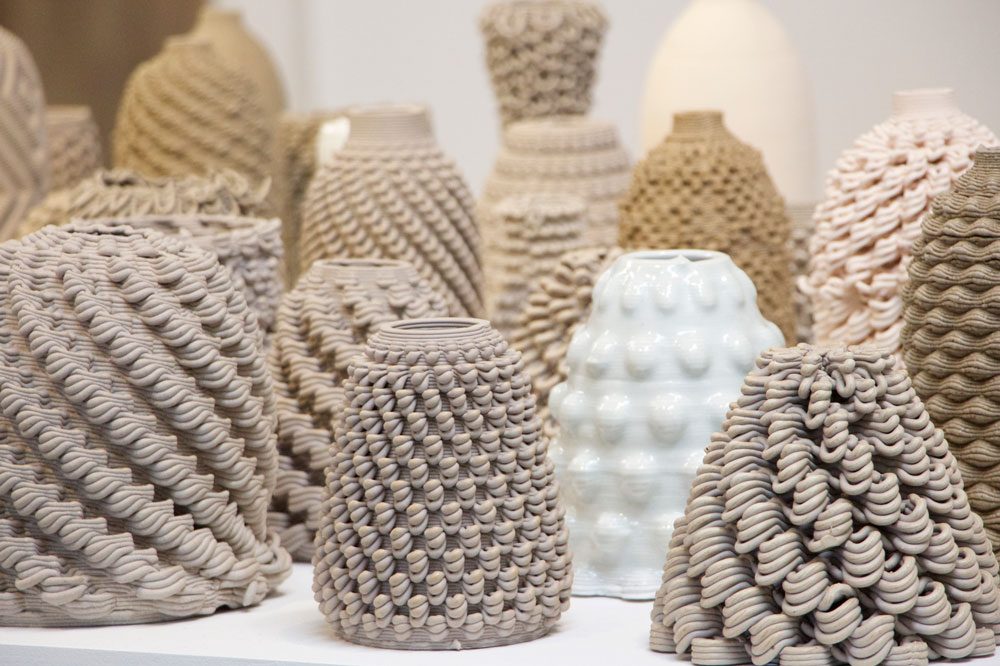
Amazing company, Emerging Objects, just introduced a wonderful new innovation in 3D printed ceramics with their project GCODE.Clay. They were previously involved in another successful ceramic 3D printing project at UC Berkeley I blogged about. This time the resulting pieces are smaller but experiment with several different mediums - porcelain, bmix, terra-cotta, and recycled clay – as part of an exhibition showcasing patterns. The article goes onto note: “GCODE.Clay was first exhibited at Space 2214 in its inaugural exhibition investigating Pattern, Predictability, and Repetition, which explored the themes of repetition, and rote action—a defining peril of modernity. In this project, the unpredictability is the fundamental aspiration of the object making. Patterns emerge and disappear in the variations of the experiments explored.”

GCODE is actually the design computer language used but I’m more interested in the results. Here the pieces capture subtle visual rhythms I quite like and the tiny imperfections (seen in the close ups) lend the pieces great warmth. The architect in me deeply questions the structural properties of said pieces in addition to their wear patterns over time. Setting these pieces in a gallery is very different than placing them architecturally in a busy public space.


So what do you think? Quirky experiment or revolutionary architectural feature? Leave your comments below!

Thursday, April 14, 2016

Architecturally 3D Printing Art History


With a great title like “WinSun 3D Prints TwoGorgeous Concrete Chinese Courtyards Inspired By Ancient Suzhou Gardens” I enthusiastically clicked through to the article only to be immediately underwhelmed. I’ve come back to the piece several times in preparation for this post but my conclusion remains changed: Great technology, mediocre architecture. With a background in architectural history perhaps I was expecting too much (being somewhat familiar as I am with Chinese architecture from previous trips to the region). Perhaps the overcast skies drain the images of any sort of life. The project looks endowed with the wrong type of stillness; the kind brought about from non-use and loneliness. For comparison I’ve included a picture of a 12th century Suzhou Garden. One can see the underlying “blockiness” of the forms are similar but real 12th century gardens include a lot more detail and texture missing from the 3D printed version. These visual elements are key as to why people are drawn to historic buildings in the first place.
Real 12th Century Suzhou Garden
Stories about the art history angle to architectural 3D printing now routinely appear online - such as the SyrianPalmyra Arch - and for the most part I’ve past over them for recognition on the blog because I haven’t found them to be truly compelling examples, even if the technology shows great promise. WinSun executive Ma Yi He’s statement about the project - “I like the 3D printing technology, its science, art and simple culture” - draws us to the crux of the conversation: Should architectural 3D printing be leveraged to define new architectural forms or perfectly represent old ones? I’ve covered the debate before with Dutch designer Michiel van der Kley going way over the top to call for a whole new design language be established around architectural 3D printed forms. I like old buildings so I wouldn’t go that far but do think the Suzhou Garden project would have been more successful had the medium been explored further. From a technological standpoint I really liked the Suzhou Gardens project. The sweeping curves achieved and textured finish (below) have all sorts of great interior and exterior applications. 


Monday, February 08, 2016

Indoor Desktop 3D Printing Warning


Previously I had joked about 3D printing Star Wars figurines at one’s desk and though I still find that image funny recent news highlights an important safety issue to consider before starting your 3D printing project: The process of 3D printing polymers produces volatile organic compounds (VOCs) and ultra-fine particles (UFPs) as a by-product. And while I’m not aware of any acute health risks of printing indoors – no one is dropping to the floor in distress – I’m also not willing to take the risk and sit beside one of these things indoors for months on end – I’d put it in the garage – and so therefore it seemed only fair to pass along on such information to our readers to make up their own minds.