As people wake up this morning around the world they will want details about North Korea’s successful nuclear test. The 7:00 PM news here was stretched to a full hour but I would not call it enlightening. Since lunch when news first trickled in, only one national channel interrupted programming for extensive coverage. After a short announcement, other channels quickly returned to normal programming (consisting, for example, of a celebrity baseball game and a timely program about Korean cooking hosted by a popular Japanese physic). The extended coverage on BS1 was not much more helpful; they had a long string of talking heads – I mean analysts – that explained who had predicted what successfully and who had been wrong.
Tomorrow I know that all of Japan will be abuzz and only in part because we are in the direct line of fire. The issue within Asia had been growing for a long time, and this was a major escalation. As I watched the news - always clumsily translated into English – it became clear it was simply going to be a long litany of everyone making official statements. (And I mean everyone.) Other than outlining the history of the issue, there was very little analysis. But to be fair, there is very little to go on at the moment. The political ramifications in Japan are enormous.
The online reaction took an interesting turn early on; that of humor. Not the obvious reaction, I agree, but isn’t there always some sharp truth to the heckles of the jester? Hawks in Asia will attack the long policy of appeasement (which I agree should be closely examined), but with humor and satire the internet community quickly exposed a far more complex picture of today’s developments. I considered posting some of the more humorous comments but realized an intimate knowledge of Japanese current events and extensive background information is needed for it to be funny; but really, believe me, it was funny.
Below, I humbly offer what little insight I have into the issue. (I apologize for its lack of humor.)
What has always struck me about people that go on to get doctorates in geo-politics is the large gap that lays at the foundation of their discipline. They’ve glossed over it long enough that one day an enterprising professor will re-define the subject and what has always been a weakness will become someone else’s problem. While one goes across the scale of person-to-person relationships governed by laws, to international relationships, there is a great discontinuity. A primary factor in the leading so-called "realist" camp is the anarchical environment in which the international politik works. There are no laws; only the powerful (using various means) are obeyed, all other structures are superficial. But in the common sense world we inhabit – outside of text books - a country is not an entity one can shake hands with; a country is led by a group of individuals. And so while internally we are bound by laws; internationally it becomes something out of Nietzsche. Which is fine with me really, if that’s how it works. But the line has to be defined for their conclusions to valid, and they haven’t even remotely acknowledged the it. To dramatically over simplify it: Why can’t one person force their will on someone by holding a gun to their head domestically, but at the same time hold basically the same guiding philosophy internationally? It is morally ambiguous at best. This is not a comment on U.S. politics. This is simply what is taught at universities across the West. It can’t be helped if some find their way into various governments.
Very little of what geo-political researchers have ever predicted has come true. But I made a prediction years ago that has held true. Don’t plan a parade yet. I’ll be honest and admit it didn’t take an advance degree or much brainpower to work it out; it only took what little common sense I have (see the post about the most dangerous meal of the day). A pre-emptive doctrine, while sounding heroic, is not pragmatic, and leads to the opposite result; that of an arms race. Flashback: Saddam has weapons of mass destruction and must be taken out. Are you sleeping better now because Saddam is in jail? And more importantly: Did Iraq have weapons of mass destructions at all?
The second question is of key importance because Iraq didn’t. To a small country which views America as a predatory superpower, Iraq becomes a very clear example of what happens to countries that don’t possess weapons of mass destruction as a deterrent. They get taken over in a matter of days. This becomes a very powerful rational to develop weapons of mass destruction.
So how would I fix it? Well firstly, I want to be clear I didn’t get us into this situation. (So no time outs for me please.) I will proudly take what responsibility I have in correcting the issue seriously. The people that guided us to this point were the same group of people with fancy geo-political degrees from Harvard and Toronto. And in the near future, as encouraging as this may seem, they will be in charge of fixing it. What becomes a simple question of morals in domestic situations becomes immensely complex on the international stage. Reality has a nasty way of rearing its head into even the best planned policy.
Monday, October 09, 2006

Sunday, October 08, 2006
North Korea Nuke
I know it is very late in Canada but there was successful test of a nuke in North Korea. I will have to watch the 7:00 news today because all heck is going to break lose politically in Japan. Details can be found on The Drudge Report to which there is a link to on my sidebar.
Blogging
Went to the Soba festival today. It stopped raining but was very cold. Needless to say, I choose hot soba. I'm doing writing this afternoon and will give a longer post tomorrow.
Thursday, October 05, 2006
Good-Bye grade 10s, Hello Friday
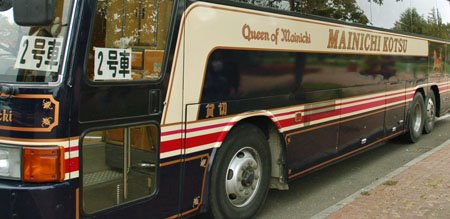
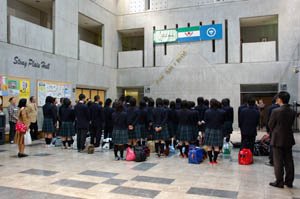
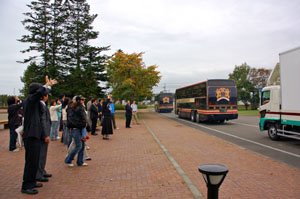
It's Friday again - and while there's only a skeleton crew at work in the office - I still feel very rushed. I had a full past two days. For example, I was at Chomin Hall this morning at 7:30 AM to see the grade 10 class off. Both my bosses are going on the trip too, as representatives for Shikaoi; already the office is dressing more casual. Also, Hosono-sensei, principal of Shikaoi High School and all around great guy, will be staying at my house in Stony Plain. It's a big treat for my family because he also stayed at our house two years ago. (I have Vivian-sensei to thank for the pictures in this post.)
Also this weekend is Shikaoi's BIG soba festival. Many soba shops will be set up in Chomin Hall's parking lot attracting thousands of visitors over the weekend. It's suppose to rain tomorrow, so I am trying to rally a posse to go Sunday. I hope it will be nice weather because last year was a lot of fun. The history of the Soba festival is short but interesting: Basically the town stole the idea of a Soba festival from neighboring Shintoku about a decade ago. Now both towns herald themselves as "Soba Capital of Japan"'s.
In a big step today, I ran the grade one/two English class at Kamihoronai Sho by myself. The homeroom teacher was away on business and thus teaching the class fell upon me. The school is very small and lacked flexibility to cover the class and I was more than happy to help. The homeroom teacher left some instructions and materials for me. It was a big success not only from a technical stand point (full marks for finishing everything I needed to do exactly on time) but we all had a lot of fun do it. The class is only two girls, so don't get the impression that this was an epic record-breaking accomplishment. The girls are, understandably, best friends and make for an amusing pair to teach. The homeroom teacher and I often can't keep a straight when dealing with them. What really makes the pair such a joy to teach every week is that they are so quick to laugh - maybe too much so sometimes - I can never bare telling them to stop in a world I know is not perfect and will certainly give them opportunity enough to cry in the future.
Another reason to lift my mood today, as if being the weekend isn't enough; it's a long weekend!
Grade 10 Departure
I just saw the Grade 10s off to Stony Plain from Chomin Hall. I will give a full account later.
Wednesday, October 04, 2006
Busy Tomorrow
I have a very busy day tomorrow that includes my normal classes, some sort of store festival run by my elementary students, a speech contest, and a teachers vs. grade six baseball game. It only looks like because its all in one spot and happens to all occur before 5 PM. I probably won't find time time in front of a computer tomorrow.
Tuesday, October 03, 2006
Chopstick relay
We developed a very good game for the grade six English class that included using chopsticks as a vocabulary builder. The point of the game was to go find an English word written on a piece of paper and run it back to your team holding it with the chopsticks. The class is wild about most anything and did very well. The relay had a very good pace that kept everyone excited and focused. The activity also included that all important factor of danger as 11 and 12 year olds sprinted around the room with pointy chopsticks. Very fun to watch.
Oh Canada Karaoke
Normally, my humorous posts reflect my job working with kids, but today I bring a story from the high school where the grade tens are preparing for their trip to Canada. I was invited to watch the dress rehearsal of the cultural showcase which the students are to present in Stony Plain. Everything was going smoothly until suddenly I was offered a mic and asked to please familiarise them with "Oh Canada." I declined the mic but that did not save me from the absurdity to follow. The first obstacle was the recording - which I hope in the name of all that is good is changed for the farewell dinner; the opening just started into the lyrics with no smooth lead in, this meant we always came in late. Furthermore, the graduations between loud and soft were extreme, meaning sometimes you could not hear the recording but by the next line it was clipping the speakers and all the time we are losing where we are in the song. The anthem seemed longer that I remember. Secondly, getting the students to actually move their mouths to sing was important. I could have juggled fire and still got less of a response so I fell back on my many elementary skills and just had them repeat after me. That seemed to be wanted the teacher wanted and after that I was able to retreat to the side of the gym with my dignity intact. And yes, I am completely tone deaf as you would except; my brother definately got those genes.
Monday, October 02, 2006
Earthquake Drill at School
My Monday wasn't exactly shattered by the earthquake drill, nor was it particularly interesting, but, being from Alberta, such things stick out in my mind as foreign and thus make a good topic for comment. Many drills are carried out every year but because I move around between schools so much, normally miss them. I was only in the school second period, but not in class, for the drill today. A loud siren went off, signaling the quake and everyone got under their desks (to protect their head, which I immediately bumped anyway). When the siren stopped, it meant the end of the earthquake, and next everyone had to quickly exit the school to be counted. The evacuation outside is necessary because the condition of the school is never immediately known; there could be a gas leak or major structural damage. I had never made the connection before but all first floor classrooms (used by grade one and two) have doors leading directly outside (but rarely used), making evacuation in an emergency quick and efficient. After assembling outside, the principal gave a short speech on some of Japan's recent big earthquakes, including the 2003 8.0 earthquake centered on the North side of Hokkaido. He included a description of the condition of Shikaoi Elementary School after the quake. After unsettling the kids enough, he casually told them to remember today's drill.
What is known in the West as the Kobe Earthquake (Jan. 17 1995) is known here as the Great Hanshin Earthquake. This is because the actual epicenter was 20 km under the Hanshin peninsula, about 20 km away from Kobe. However, Kobe was by far the nearest high-density population center and, as result, had the most damage. (The earthquake itself was big enough to cause a dip in Japan's GDP.) As a consequence of the Kobe earthquake there have been two general changes to Japan's emergency preparedness. Firstly, the science. While the earthquake only measured 7.2 on the Richter scale, it was located directly under land; a situation scientists had previously thought impossible (believing instead that these quakes occurred off the coast). And secondly, the Kobe earthquake triggered a massive restructuring of Japan's response plan. Japan had been prepared before, but the Kobe earthquake was a large-scale testing of their system, and afterward thousands of refinements and improvements were made. Interestingly, across the country they revised upwards their worst case scenarios and started to stock more of everything. In terms of tweaks, they now make sure, on top of the normal emergency rations, there is a variety of specialized rations for people with dietary restrictions.
I find the relationship between architecture and earthquakes in Japan a fascinating topic deserving it's own book. I will try to continue the discussion in the future.
What is known in the West as the Kobe Earthquake (Jan. 17 1995) is known here as the Great Hanshin Earthquake. This is because the actual epicenter was 20 km under the Hanshin peninsula, about 20 km away from Kobe. However, Kobe was by far the nearest high-density population center and, as result, had the most damage. (The earthquake itself was big enough to cause a dip in Japan's GDP.) As a consequence of the Kobe earthquake there have been two general changes to Japan's emergency preparedness. Firstly, the science. While the earthquake only measured 7.2 on the Richter scale, it was located directly under land; a situation scientists had previously thought impossible (believing instead that these quakes occurred off the coast). And secondly, the Kobe earthquake triggered a massive restructuring of Japan's response plan. Japan had been prepared before, but the Kobe earthquake was a large-scale testing of their system, and afterward thousands of refinements and improvements were made. Interestingly, across the country they revised upwards their worst case scenarios and started to stock more of everything. In terms of tweaks, they now make sure, on top of the normal emergency rations, there is a variety of specialized rations for people with dietary restrictions.
I find the relationship between architecture and earthquakes in Japan a fascinating topic deserving it's own book. I will try to continue the discussion in the future.
Subscribe to:
Posts (Atom)